
Namespaces
Namespaces group statements into nested sub-graphs (compound nodes). They give both scope isolation and visual hierarchy in the rendered DAG.
Basic Namespace
Wrap statements in square brackets with a name:
prep[
  a = mix()
  b = knead(a)
]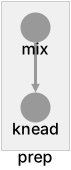

This creates a compound node prep holding the nodes its calls create (mix and knead) and the edge between them. In the visualization, those nodes are drawn inside the prep box.
As everywhere else, only calls create nodes: a and b are names for mix's and knead's nodes, and a is what draws the mix → knead edge. See Calls & Variables.
Namespaces with Arguments
Pass arguments into a namespace by adding an argument list after the closing bracket:
d = fetch()
prep[
  a = knead()
](d)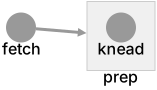
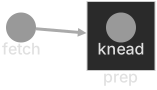
The edge runs from fetch to the prep compound node itself where the box is the endpoint. A namespaces's argument does not reach in and attach to a particular node inside.
Namespaces with Styling
Apply styles to the compound node itself:
prep[
  a = knead()
](){ background-color: "wheat" }

The empty () can be omitted if you only need styling:
prep[
  a = knead()
]{ background-color: "wheat" }

A *subgraph global style binding styles every compound node at once.
Anonymous Namespaces
Omit the name for an unnamed grouping:
[
  a = mix()
  b = knead(a)
]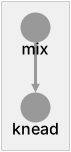

An anonymous namespace still creates a compound node, but with no name it has nothing for a qualified reference to address, so nothing outside can reach into it.
Scope Isolation
Variables defined inside a namespace are scoped to that namespace. Access them from outside with a qualified name:
fryer[
  donut = fry()
]

// Access from outside:
plain = cool(fryer.donut)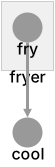

Unlike an argument into a namespace, a qualified reference reaches the inner node: the edge here runs fry → cool, crossing the namespace boundary rather than stopping at the box.
Referencing a name that the namespace does not define reports REF_VAR_NOT_FOUND.
Style tags are scoped the same way, and are referenced as #fryer.tagName — see Qualified Style Tags.
Nesting Namespaces
Namespaces nest to create deeper hierarchies, and qualified names chain:
outer[
  inner[
    y = f()
  ]
  z = g(inner.y)
]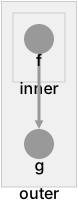

The f → g edge crosses out of inner while both nodes stay inside outer.
Assigning Namespaces
A namespace can appear on the right-hand side of an assignment, which names the compound node:
d = fetch()
batch = prep[
  a = knead()
](d)

fry(batch)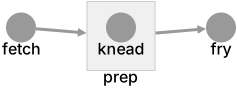
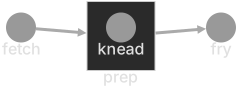
batch refers to the prep box, so fry(batch) draws an edge from the box to fry.
Assigning a namespace to a variable is the only way to pass it as an argument to a call. The fiz language intentionally disallows namespaces to be passed directly into calls for readability purposes.
Layout Note
Namespaces are compound nodes, which not every layout handles. The breadthfirst layout ignores compound parents and will draw children over the namespace box; dagre and elk both nest correctly. See Renderers.